
June 15, 2026 – If you’ve been waiting for a sign that the housing market is picking up, this is it. The National Association of REALTORS® just released its May 2026 existing-home sales data, and the numbers tell a clear story: more Americans are buying homes again and the Midwest is outpacing the rest of the country.
Here’s what that means for buyers and sellers right here in eastern Iowa.
The Midwest Had the Biggest Sales Jump in the Nation
Of all four major U.S. regions, the Midwest saw the largest month-over-month sales increase in May, a 6.4% jump compared to April. That’s not a rounding error. That’s real momentum, and it’s reflected in what we’re seeing on the ground across communities like Cedar Rapids, Iowa City, Dubuque, Davenport, and the Corridor.
The Midwest median home price in May was $336,300, up 2.8% from a year ago. That’s meaningful appreciation, but it still puts our region far below the national median of $429,300 and a world away from the West’s median of $625,900. For buyers priced out of coastal markets or even larger Midwestern metros, eastern Iowa continues to offer genuine value.
Affordability Is What’s Driving the Recovery
NAR’s chief economist Lawrence Yun pointed directly to improving affordability as the engine behind rising sales. Mortgage rates averaged 6.44% in May, still elevated by pre-2022 standards, but notably lower than the 6.82% average from May 2025. That difference matters when you’re calculating a monthly payment.
At the same time, income growth has been slightly outpacing home-price appreciation in most parts of the country. Eastern Iowa has long benefited from a strong employment base, healthcare, manufacturing, tech, and education, which helps local buyers stay competitive even as prices tick upward.
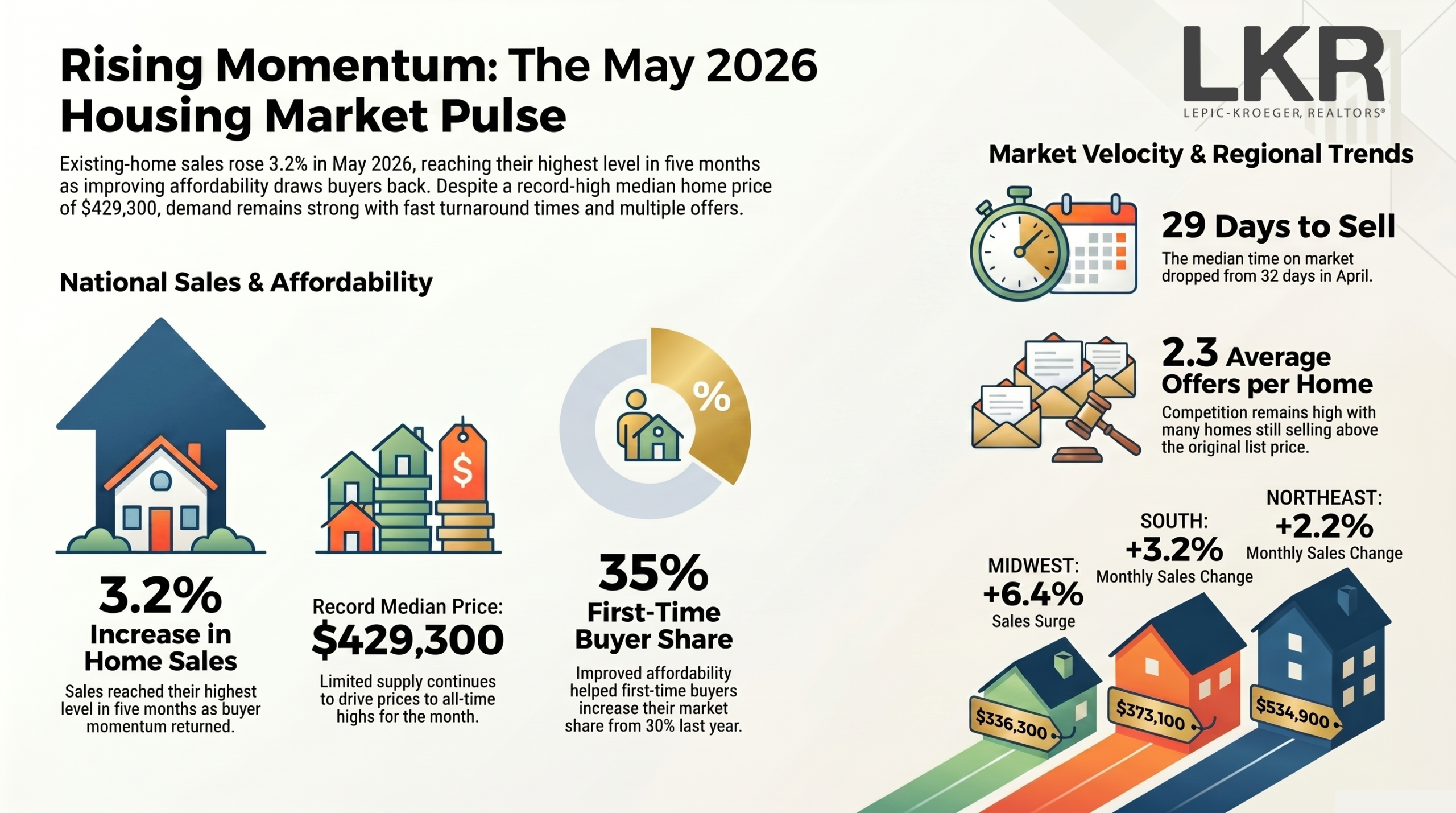
May 2026 National Housing Market
First-Time Buyers Are Back
One of the most encouraging data points in the NAR report: first-time buyers made up 35% of existing-home sales in May, up from just 30% a year ago. That’s a significant shift. In markets like ours, where starter homes are still within reach and the cost of living remains relatively low, that trend is even more pronounced.
If you’re a first-time buyer who stepped back from the market over the past couple of years, conditions are more favorable now than they were in 2024 or early 2025. Rates are down, more homes are coming to market, and you have more negotiating room than you did during the peak frenzy.
Sellers: You’re Still in a Strong Position
Don’t mistake increased buyer activity for a market that’s swung in favor of buyers. Nationally, about 25% of homes sold above list price in May, and homes received an average of 2.3 offers. The median days on market dropped to just 29 days.
Supply remains tight. While the number of homes for sale is up slightly, it’s growing far more slowly than buyer demand. That dynamic, more buyers, not enough homes, is what keeps upward pressure on prices. The record-high May median price of $429,300 nationally (with our region at $336,300) reflects this imbalance.
For sellers in eastern Iowa, this means well-priced, well-presented homes are still moving quickly and often generating multiple offers. If you’ve been thinking about listing, you don’t have to time the market perfectly, the fundamentals are working in your favor right now.
What to Watch Going Forward
The NAR data represents a national snapshot, and local markets always have their own nuances. A few things worth watching as we move into summer:
Inventory. More homes are coming to market, which gives buyers more choices. But supply is still well below what’s needed for a fully balanced market. Until that gap closes, sellers hold the advantage.
Rates. The 30-year fixed rate is in the mid-6% range. Any movement downward, even a quarter point, tends to bring more buyers off the sidelines.
Economic confidence. Job stability and income growth are what ultimately drive housing decisions. Eastern Iowa’s diverse economy has been a buffer against broader volatility, and that’s a real asset for our local market.
Whether you’re thinking about buying your first home, selling and right-sizing, or just trying to make sense of what’s happening in the market, we’re here to help. The numbers are encouraging — and local expertise makes all the difference in turning national trends into smart decisions for your specific situation.
Data sourced from the National Association of REALTORS® existing-home sales report, May 2026.